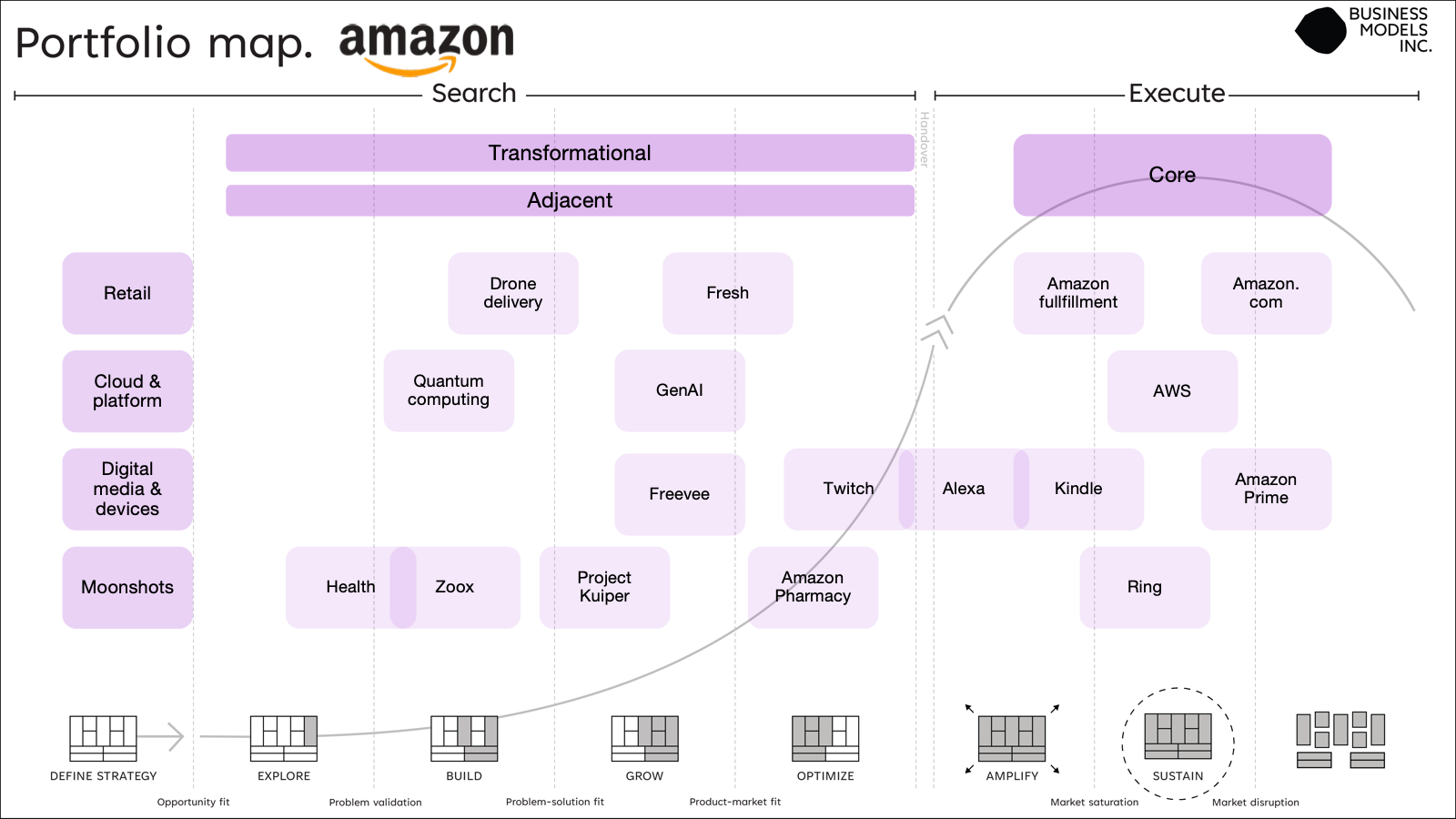
A look inside Amazon's portfolio:

How Jeff Bezos manages 30+ business models simultaneously.


Jeff Bezos started with books. Today, Amazon runs satellite networks, quantum computers, and a cloud empire that powers the internet. Thirty different business models, all at once. Sounds like chaos? It's the opposite: portfolio management as a core discipline.

While most companies struggle with one business model, Amazon manages dozens. The secret? They manage phases, not projects. They finance the future from their core. And they never stop experimenting. Take a look under the hood of the world's most complex portfolio.

From books to (almost) everything.

Amazon's evolution isn't linear. It's not a story of "we did this, then we did that, and now we do this."

It's a story of strategic optionality.

  • 1994: Online books

  • 1998: Music and videos

  • 2002: AWS starts as an internal tool

  • 2005: Prime membership launch

  • 2006: AWS goes public

  • 2007: Kindle revolutionizes reading

  • 2011: Amazon Studios (content production)

  • 2014: Alexa and Echo

  • 2017: Whole Foods acquisition

  • 2020: Pharmacy launch

  • 2023: Kuiper satellites begin launching

What stands out? Amazon never stops experimenting. Not even when the core business generates billions.

But here's what most people miss: this isn't chaotic opportunism. This is disciplined portfolio management.

Ready to experiment with discipline like Amazon? Let us help you with your strategic portfolio management.

The portfolio reality: one company, dozens of business models.


The outside world sees "Amazon." But inside? That's dozens of separate business models, each with its own value propositions, cost structures, and growth potential.


Let's categorize them along the portfolio lifecycle; from fully mature to fully experimental.

Core: The profit machines (Execute phase)

These are the business models that form Amazon's financial foundation. They're proven, profitable, and scalable.

Amazon.com (E-commerce)

  • The original model, now a $470+ billion revenue machine

  • Mature operation with razor-thin margins but enormous scale

  • Focus: operational efficiency and customer experience optimization


Amazon Web Services (AWS)

  • The cash cow: ~$90 billion revenue with 30%+ margins

  • Started as an internal experiment, now market leader in cloud

  • Focus: enterprise growth and technological leadership


Prime Membership

  • 200+ million subscribers worldwide

  • The glue model that holds everything together

  • Focus: retention and ecosystem lock-in


Fulfillment Network

  • Possibly the most valuable asset: the logistics network

  • Scale that no one can replicate

  • Focus: speed and cost reduction


These four models generate virtually all the profit. They're mature. They run on execute principles: efficiency, predictability, scale.

And here's the trick: these models finance everything that's coming.

Adjacent: The growth initiatives (Build/Grow phase).


These are business models that have demonstrated potential, but aren't mature yet. They expand Amazon's reach into adjacent value spaces.


Alexa & Echo

  • Voice-first computing platform

  • Not yet profitable, but strategically essential

  • Learning goal: own the interface of the future

Kindle & Digital Publishing

  • Changed how people read

  • Created new revenue model (content + hardware)

  • Proven concept, now optimizing for scale

Ring & Smart Home

  • Acquisition that brought Amazon into home security

  • Integrates with Alexa ecosystem

  • Proven traction, now expanding to adjacent services


Amazon Pharmacy

  • Disruption of $500 billion industry

  • Early stage, but clear problem-solution fit

  • Builds on existing capabilities (logistics, Prime)


Twitch

  • Leader in live streaming for gaming

  • Own ecosystem with creators and viewers

  • Monetization models still in development


Amazon Advertising

  • $40+ billion business that's barely visible

  • Competes directly with Google and Meta

  • Fast-growing, but not yet optimized


What these models have in common: they're beyond the experimental phase, but not yet mature. They require investment, but show proof of traction.


They're in what we call the "grow" phase: problem-solution fit is proven, now it's about finding product-market fit and scaling.

Transformational: The moonshots (Search/Explore phase).


These are the high-risk, high-reward experiments. Most will fail. Some could redefine Amazon.


Project Kuiper

  • Satellite internet constellation (competitor to Starlink)

  • $10+ billion investment

  • No revenue yet, pure strategic bet

Quantum Computing (Amazon Braket)

  • Access to quantum computers via AWS

  • Years away from mainstream, but could-be game-changer

  • Taking position in emerging technology

Amazon Go / Just Walk Out

  • Cashierless stores with computer vision

  • Concept proven, but scalability uncertain

  • Learning: can this fundamentally change retail?


Zoox (Autonomous Vehicles)

  • $1.3 billion acquisition in 2020

  • Robotaxi service, completely own design

  • High uncertainty, high potential impact

Amazon Care (paused, but telling)

  • Virtual healthcare experiment

  • Didn't go as expected, but learned a lot

  • Example of: experiment, learn, pivot or stop

These initiatives have something in common: they're uncertain, expensive, and potentially transformative. Amazon doesn't treat them as normal business units. They get different metrics, different time horizons, different governance.

They're in pure search mode: exploring, testing hypotheses, learning fast.

Value Spaces: How Amazon creates structure.


With 30+ business models, chaos threatens. How do you prevent everything from becoming a mess? Amazon organizes their portfolio in value spaces: strategic themes that cluster around customer needs and capabilities.

1. Retail & Commerce

"Help people buy and sell things"

  • Amazon.com, Marketplace, Amazon Fresh, Whole Foods

  • Core competency: logistics and customer experience

2. Cloud & Platform

"Deliver the infrastructure that powers the digital economy"

  • AWS, Amazon Braket, enterprise tools

  • Core competency: scalable technology


3. Digital Media & Devices

"Own the devices and content people use daily"

  • Kindle, Fire tablets, Echo, Prime Video, Twitch, Amazon Studios

  • Core competency: hardware + software + content integration


4. Health & Wellness

"Make healthcare more accessible and efficient"

  • Amazon Pharmacy, Amazon Care (paused), health tech experiments

  • Core competency: logistics + data + user experience


5. Moonshots & Emerging Tech

"Plant flags in tomorrow's technologies"

  • Kuiper, quantum computing, Zoox, advanced AI

  • Core competency: long-term thinking and R&D capacity


This isn't cosmetic organization. These value spaces serve three crucial purposes:

  1. Strategic coherence: Every initiative links back to an overarching theme

  2. Resource allocation: Budget decisions happen per value space

  3. Capability reuse: Initiatives within the same space share tech, data, and expertise

The Amazon Portfolio Map.

When we visualize Amazon's portfolio on the lifecycle curve, this picture emerges:


What do you see?

  • Heavy right: Most resources sit in mature core (as they should)

  • Filled middle: Multiple adjacent bets in different growth phases

  • Consistent left: Always new transformational bets in development

  • Spread across value spaces: No cluster in one area, but distribution


This is no coincidence. This is design.

Is your organization struggling with portfolio chaos? Let's define your value spaces together.

4 lessons from Amazon's portfoliomanagement.


You're probably not Amazon. You don't have their resources, their scale, their margins on AWS.

But the principles? They're applicable.


Lesson 1: The core finances the future.

Amazon's moonshots cost billions. Kuiper alone is $10+ billion. How can they do that?

Because AWS generates 30%+ margins that make experimentation possible. Without profitable execute, there's no budget for search. Too many organizations try to innovate while their core business is faltering. That doesn't work. Fix your foundation first.

The lesson: ensure your core business is healthy and profitable. That's not boring—that's the prerequisite for innovation.

Lesson 2: Manage phases, not projects.

Amazon doesn't treat Kuiper like they treat AWS. Different metrics. Different governance. Different time horizon. They adapt their management to the lifecycle phase. An initiative in search doesn't get the same KPIs as an initiative in execute. That would be ridiculous. And yet most organizations do exactly that.

The lesson: recognize which phase each initiative is in, and adapt your expectations, metrics, and management accordingly.

Lesson 3: Value spaces prevent chaos.

With 30+ business models, Amazon could be an unorganized conglomerate. But they're not, because everything clusters around strategic themes. Value spaces provide direction without rigidity. They tell teams: "We innovate in these domains, with these capabilities." That prevents each team from choosing its own direction. And it prevents duplicate effort.

The lesson: define 3-5 value spaces where your organization excels and wants to grow. Let all initiatives fall within them.

Lesson 4: The portfolio is never 'finished.'

Amazon doesn't stop innovating. Not even now that they're a $1.5 trillion company. Why? Because markets don't stop evolving. What's core today gets disrupted tomorrow. Amazon knows that. So they keep planting in the future, even when the current harvest is abundant.

The lesson: portfolio management isn't a one-time project. It's an ongoing discipline. You must continuously evaluate, reallocate, and place new bets.


Mapping your portfolio.

Amazon's portfolio is complex, but the principle is simple: know what you have, know where it stands, manage it consciously.

The questions you need to ask:

  • Which of our business models are core (and finance the rest)?

  • Which are adjacent (and can grow into core)?

  • Which are transformational (and can redefine us)?

  • In which value spaces do we want to excel?

  • Do we have the right balance between now and later?


If you can't answer these questions clearly, you don't have a portfolio strategy. You have a collection of initiatives. And collections get beaten by systems.

Looking for extra brainpower to help you innovate?